www.enjoy-machu-picchu.org
Machu Picchu
Site Map
Machu Picchu
Historical Information
Machu Picchu
General Information
Machu Picchu
Useful Information
Machu Picchu
Other Information
Machu Picchu
Attractions
Machu Picchu
Surroundings


MACHU PICCHU'S LOCATION

PERU

by
Enjoy Peru
Machu Picchu Travel
Home Page
Site Map
Historical Information
   History of
Machu Picchu
   History of the
Tahuantinsuyo Empire
   Discovery of
Machu Picchu
   Legend of the
Ayar brothers
General Information
   Climate
   Health
   Historical Sanctuary
   Transportation
   Engineering
   Architecture
   Sectors in
Machu Picchu
Attractions in
Machu Picchu
Surroundings in
Machu Picchu
Machu Picchu
Pictures & Photos
Machu Picchu
Useful Information
Machu Picchu
Adventure Travel
ENJOY PERU S.A.
Main Headquarters
Schell 343 - Of. 607
Miraflores - Lima 18
PERU
Tel: +51 1 702-2000
Fax: 511-445-1750

TOLL FREE numbers:
USA: 1-888-317-3383
UK: 0-800-097-1749

http://www.enjoyperu.com


PHOTOS MULTIMEDIA GALLERY OUR
OFFICES
TRAVEL AGENTS
Call our TOLL FREE number: USA: 1-888-317-3383   UK: 0-800-097-1749
 Business Hours: Monday to Friday: 9 am - 6 pm Peruvian Time Zone: GMT -5 hours

UK toll free number is temporary out of service. Please be so kind to contact us by clicking here


MACHU PICCHU MACHU PICCHU MACHU PICCHU
City: Machu Picchu District, Urubamba Province, Cusco State. It is located at kilometer 112.5 (70 miles), to the northwest of Cusco City.

Location : It is located in the southwestern Andes, in the Valley of Huatanay River. Machu Picchu is at Southern Latitude 13°09'23'' and at 72°32'34 '' West of Greenwich Meridian.

Height: Machu Picchu is at 2,450 meters above sea level (8,038 feet)
If we take the Citadel's Central Square as a reference point, Machu Picchu is at 2,490 meters above sea level.

Surface Area
Machu Picchu's urban and rural Archaeological Park, that is to say, the citadel itself, has a surface of about 10 hectares.
Machu Picchu's Historical Sanctuary has a surface of 32,592 hectares or 80,535 acres (325.92 sq km; 125.83 sq m); it is a vast region in Urubamba Province, in Cusco State.

POPULATION

Further to information provided by INEI (Institute of Statistical Information) in the 1993 Census, Machu Picchu District's population was of 2,298 inhabitants. Ten years later, its population grew to more than 5,500 inhabitants due to the high migration rate. Itinerant population is significant and it mainly includes travelers from all over the world, tourist staff and traders.

The government created Machu Picchu's Historic Sanctuary by passing the 001-81-AA decree-law on January 8th, 1981, in order to protect and preserve not only Machu Picchu's archeological value but also its magnificent natural environment of unique flora and fauna and its beautiful landscapes of surrounding woods.

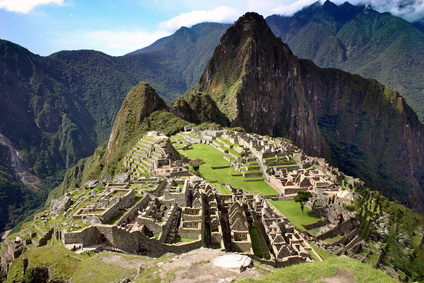
Machu Picchu Historic Sanctuary (Cusco-Peru) is strategically situated at the top of the Machu Picchu Mountain, at 2,350 meters above sea level, in Vilcabamba Mountain Range's western slope. The Vilcabamba Mountain Range is bordered by the Apurimac and Urubamba Rivers. The Historic Sanctuary is specifically located in the Valley of the Urubamba River (Also known as Vilcanota), at the lower part of the Holy Valley of the Incas, where you can access the high forest.

The Valley of the Urubamba River crosses the Sanctuary Region. This River descends from the snow-capped Andes at more than 6,000 meters above sea level. The river rushes with choppy waves on this lower part of the mountain range, showing its might. At the same time, it crosses the solid barrier of the Andes, creating an appealing landscape. The imposing Salkantay (at 6271 meters above sea level), the largest snowcapped mountain in the Vilcanota Mountain Range, dominates the Sanctuary's landscape. The local town-dwellers worship this mountain as Apu (a protecting divinity). Machu Picchu combines the magnificence of natural, immensely beautiful surroundings with the beauty of the most famous pre-Hispanic ruins worldwide.

Within the Sanctuary, there are other ancient smaller towns as well as isolated buildings that used to provide lodging for travelers, control posts and, what are perhaps the most amazing production centers anywhere, with farming terraces (platforms) and complex irrigation systems. All these buildings are connected with each other through a sophisticated network of stony tracks, the Inca Trail.

Although Machu Picchu's purpose is not clearly known, it undoubtedly formed part of a complex of Inca fortresses at the time it was built. These Inca fortresses protected the Holy Valley's Inca territory from the "Indians of the Forests". Cusco's Aguas Calientes railway has a station known as Puente Ruinas that is at 2,000 meters (6,560 feet) altitude. Buses leave this station for the most famous Archaeological Center of South America (the trip takes 3 hours and 30 minutes by train) up to the area of Aguas Calientes; and from there, they go another 8 kilometers uphill, along the mountain slope, up to Machu Picchu Citadel (25 minutes).

OROGRAPHY

The National Historic Sanctuary of Machu Picchu is located on a large orogenic granite structure of about 400 km2 (154 m2) that Dr Isaiah Bowman called "Vilcapampa". Its formation belongs to the geologic era of Paleozoic or Inferior First and its age is of, more or less, 250 millions of years.
The white-gray granite of Vilcapampa is an igneous stone made of 60% of feldspar, 30% of quartz adn10% of mica, approximately. These components have given rise to granular structure of granite that has harshness of 6 to 7 according to the Mohs scale and strength of 1200 kg/cm2. There are some other stones in this region that belong to Inferior Paleozoic, such as schist, quartzite and metamorphic conglomerations that could even be 350 to 450 years old.

HYDROGRAPHY

Machu Picchu is located between the western and central Andes mountain ranges what explains the large number of hydric sources such as surface and underground rivers and springs and thermal waters. The Vilcanota flows along the whole District of Machu Picchu and it is the main receiver of tributaries that are originated on the snowed Andes Mountain Range. The tributaries that are located at the capital of the district of Machu Picchu and that flow into Vilcanota River are called Aguas Calientes and Alphamayo.

PHYSIOGRAPHY

Due to its geographical features determined by its location in the Andes cordillera, the District of Machu Picchu displays a diversity of important differences in relief, climate, soil, vegetation and so on. Such differences determine three different types of regions:

High Mountain Area
An area of high altitude or high mountain, with numerous and frequent surface plains with slopes steeper than 45°. Heights fluctuate between 4000 and 6000 meters above sea level in snowed Salkantay and Verónica Mounts. Temperatures are below 0°C, with perpetual snows and solid precipitations.

Low Mountain Area
This is an area of mountainous slopes with heights that vary between 2500 and 3800 meters above sea level. It is characterized by seasonal rainfalls, from November to March, Machu Picchu's winter. The annual average temperature oscillates between 11ºC and 15ºC. The towns of Miscabamba and Churubamba are located in this area

Forest Area
The high forest is located at a height of 2000 to 800 meters above sea level, with semi-tropical temperatures. In this area we find Ahobamba and Collpani Grande Towns.

ROAD NETWORK and MEANS OF ACCESS

The Town of Machu Picchu is connected to the city of Cusco ("the world's navel") by means of a railway system that joins both tourist resorts. The trip takes three hours approximately, through paradise-like landscapes, covering a distance of 110 kilometers, with daily frequencies and numerous options regarding timetables, categories and fares. The only other means of access by land are any of the three "Caminos Inca", taking two, four or five days respectively.


ISO 9001 : 2000
CERTIFIED
Travel Consulting, Tourist Operation Management
&
Electronic Air Tickets Distribution


OUR TRAVEL AND TOURS SITES
IN PERU
Travel & Tours to
PERU
Cusco Peru
Inca Trail
Peru Pictures
Peru Hotels Reservations
Peru Flights

OUR TRAVEL AND TOURS SITES
IN LATIN AMERICA
SOUTH AMERICA
Travel & Tours
ARGENTINA
Travel & Tours
PATAGONIA
Travel & Tours
CHILE
Travel & Tours
ECUADOR & GALAPAGOS
Travel & Tours
BOLIVIA
Travel & Tours
MEXICO
Travel & Tours
BRAZIL
Travel & Tours


Contact Us | Contact Webmasters | Travel Agents

More Information / Resources 1 - 2 - 3 - 4 - 5 - 6 - 7 - 8 - 9 - 10
Last Update:  © ENJOY CORPORATION S.A. Rights Reserved.