"And so I climbed the Earth ladder, through
the awful labyrinth of lost jungles, up to you, Machu Picchu."
Pablo Neruda, Heights of Machu Picchu, 1950

The citadel of Machu Picchu is one of the most
famous archaeological sites in the world as well as being the archetypal
symbol of Peru and its most important historical site. It covers
an area of 5 sq km, at an altitude of 2,430 meters, in the Urubamba
River Valley.
Machu Picchu is a mystical place with a strong
feeling of spirituality. It is a monument dedicated to the relationship
man and the supernatural, magic and the commonplace - an approach
by man, the creature of the gods, to pure divinity. It is a place
where strange forces in nature enable individuals to achieve a unique
state of "cosmic awareness", a state that can only be achieved in
Machu Picchu.
Machu Picchu is a complex word deriving from machu:
"old" or "ancient", and picchu: "crest" or "mountain"; therefore,
Machu Picchu or Machupicchu may be translated as "The Old Mountain"
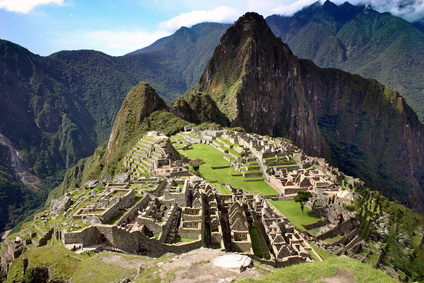
The famous mountain you can see in front of the citadel, appearing in most of the usual vistas of this place, is called Wayna Picchu or Waynapicchu ("The Young Mountain"). Unfortunately, the original names of these sites are unknown. Machu Picchu, Wayna Picchu, and some other names used today are contemporary, probably having been given by the farmers who settled in the area before Bingham reached it in 1911.
However, research dating from the 16th century shows that the area's original name could have been "Picchu".
Over time, this place's real name has been lost. Machu Picchu is just a geographical name that means "Old Mountain", opposed to Huayna Picchu that means "Young Mountain".
In order to explain the meaning of the word Machu Picchu, we have taken an extract from the book "Toponimia Quechua del Peru" (Peru's Quechua Toponyms), by Dr. Max Espinoza Galarza, who says the following: "Figuratively, machu is a majestic term to indicate seniority or deity, and picchu, in the case of the ruins may be translated as "thinker". Then, its figurative meaning is: "The Old Thinker". In Fact, picchu or piqchu means borujo (quid) in reference to the shape of a chewed coca leaf or chacchada, in Quechua. It also means a quid-like hill. So, after all this, Machu Picchu's real name would be: "The Greatest Eminence of the Hill."
The citadel of Machu Picchu is the most important national tourist attraction as well as pre-Columbian civilization's most important symbol, the prime destination for tourists. It attracts crowds of visitors and constitutes their main reason for visiting Peru.
Machu Picchu blends in stunningly
well with its surroundings, at a meeting place of tropical forest
and mountains on a plateau located on the top of an inaccessible
mountain almost totally surrounded by a cliff, overlooking the Urubamba
river, winding and weaving 400 meters below.
Machu Picchu is divided into two distinct sectors
- agricultural and urban - with marked architectural differences
according to their former functions. The agricultural sector has
agricultural terraces - the andenes (platforms). Stone stairways
protruding from the walls lead you from one terrace to the next.
The urban sector has a huge plaza surrounded by two groups of buildings
with streets and stairways totaling 3,000 steps and a very complex
network of water channels, small squares and courtyards. The one-story
rectangular buildings follow a single basic pattern.
Built of stone, the great citadel of
Machu Picchu has
huge walls, terraces, and ramps that seem to have been cut into
the flowing rock escarpments; it is probably the Inca Empire's most
impressive urban creation. To this day, it testifies to Inca architectural
skills.
The stone used for the construction is mostly locally procured granite. The shape and size of the blocks resulted from Inca stone-cutting techniques, and their finish was probably sanded. It is quite likely that the walls had originally been plastered. The fact that the blocks fit together so perfectly suggests that detailed studies were made, as in a giant jigsaw puzzle, and that the construction process was carefully planned. The perfection of the walls boggles the imagination, so much so in fact, that accounting for it calls for mythical explanations. We can certainly say that these remains date from the period marking the apex of Inca culture (1438- 1532).
The importance of
Machu Picchu citadel for Tahuantinsuyo
seems obvious. At the time it was densely populated and, without
a doubt, was the most important of all the Inca cities. It seems
obvious that these settlements were carefully planned and interconnected
one with another and with Cusco by stone-paved trails, the well
known Inca Trails. This region was partially famous for its productivity,
since most of the archaeological sites are also important agricultural
complexes. Because of the environmental conditions at Machu Picchu,
corn, potatoes, and maybe coca, were probably its main agricultural
products.